
How to use the Rules of Origin Self-Assessment tool (ROSA)
The EU’s global network of trade agreements reduces or eliminates tariffs.
To benefit from these reduced or zero tariffs, your product needs to comply with the rules of origin.
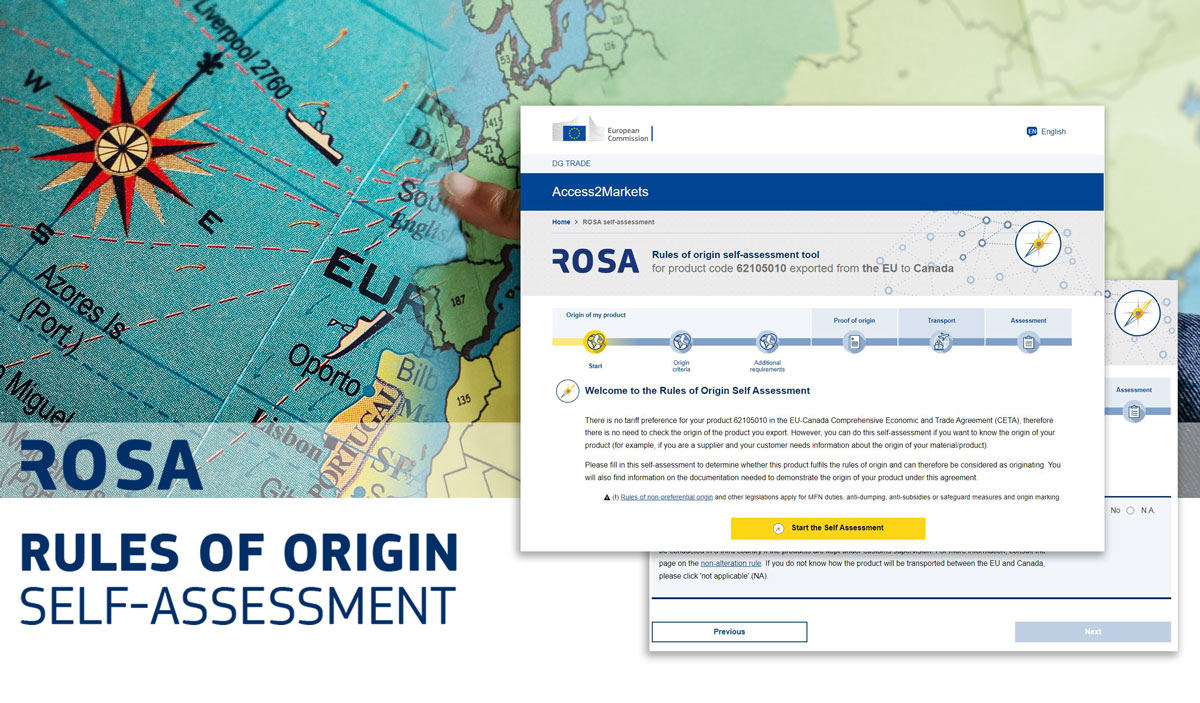
ROSA– the Rules of Origin Self-Assessment tool in Access2Markets – allows you to check whether a product complies with the rules of origin and therefore qualifies for preferential tariff treatment under a particular EU trade agreement.
ROSA is a one-stop-shop to know the rules of origin for your product in most EU trade agreements. It is free and easy to use!
What is ROSA?
The Rules of Origin self-assessment tool (ROSA) guides companies through the rules of origin that apply to their product in a particular Trade Agreement. By answering simple questions, companies can carry out a self-assessment to determine whether their product complies with these rules is therefore eligible for preferential tariff treatment. Clear explanations, examples and links to the relevant legal texts are available throughout the tool.
To make life easier for companies, ROSA gives explanations on the proofs of origin that are necessary to obtain tariff preferences.
How does it work?
Go to My Trade Assistant and
- enter the product
- enter the country of export
- enter the country of import
- click on Rules of Origin Self-Assessment (ROSA) in the left side menu to access the tool
ROSA provides you with
- a step-by-step tool with tailored questions that will guide you through the process of assessing the origin of your product
- detailed information on how to correctly document the origin of your product under each agreement
- explanations of rules of origin requirements and terms
- practical examples
- direct access to legal texts
- a customised self-assessment report based on your answers
- an overview of rules of origin procedures
- all information provided is specific to the particular trade agreement you have selected and to your product
Work directly with your suppliers
You can share ROSA with your suppliers to help them:
- check the rules of origin
- Complete their supplier’s declaration correctly
Compare rules across multiple markets
You can also to compare product-specific rules under different EU trade agreements.
General information on rules of origin
For general information about the rules of origin and the origin procedures, see the Quick guide - how to work with rules of origin.
For general information on the rules of origin in a specific agreement, see the Markets section – EU trade agreements at a glance, including their rules of origin and procedures.
To understand the basic terminology and concepts, our Glossary pages provide definitions of the key terms you need to know to understand the rules, such as wholly obtained, cumulation, tolerance, etc.